
An atmosphere of building tension. Visible is the frosty air coming from my fellow runners as they execute the "pre-race" wiggle on the starting line.
A rapid movement of the hips.
I'm at my local weekly parkrun event and I'm focused. It's almost time...
Hold on. I must adjust my device. As does the person beside me.
The person behind us sighs. I'm not moving until… yes! Signal acquired, away I go.
During the scramble, it's challenging to see a wrist without a wearable on it. And it's not just us participants who use them.
This is a booming, multi-billion pound sector. Names like Samsung Galaxy lead the market, featuring an broad range of different versions to cater to a spectrum of needs. According to how feature-packed the watch you go for, costs can start from an affordable sum to a significant investment.
"It makes me crazy, I'm unable to stop checking."
"It comforts me… It feels like a companion supporting me."
"I wish it wouldn't say I've had a bad night's sleep."
A handful of the reactions people have shared from fellow smartwatch wearers when I inquire what they their opinion is on theirs.
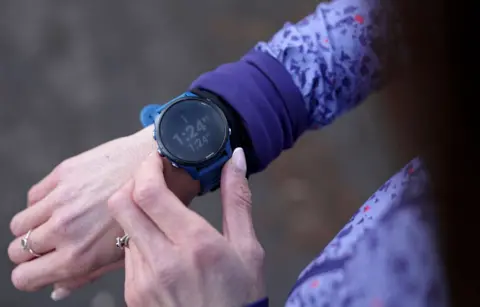
The Monitoring Conundrum
My feelings on mine? At this moment, frustrating. It's reporting I'm off pace, making me wonder whether the foliage along my route are blocking my location tracking.
A vast number of us attach these compact devices onto our wrists and wear them 24/7, apparently comfortable with the fact they're constantly recording us.
A distant memory are the days when we depended on them only to give us an idea of our pedometer reading. Currently, they can track our sleep patterns, heart rate, oxygen saturation, our body battery.
It's a challenge to find a physical metric they aren't designed to measure.
But do they do what they advertise? And are the statistics we scrutinise a faithful picture of reality? Do they improve our daily wellness, or do the plethora of measurements and constant notifications just add to our everyday anxiety?

A Complicated Bond
"I find myself getting a bit obsessed with mine," an individual reveals.
While she values how her device records her exercise, she finds some of its other features "excessive" at times - a feeling that became apparent during a pregnancy.
Before she realised she could change its configuration, her smartwatch kept telling her she was not being productive enough. Now, the watch frequently reports her she's had a bad night's sleep.
"I have a infant, I don't need to be notified I've not slept," she says. "That fact is only too well."
Couldn't she just stop wearing it?
"I suppose I could, I suppose, but I have this love-hate relationship with it," she says. "I value it for its fitness insights, I sometimes question whether the additional features it can now do is maybe excessive for me."
Inside the Device
Each model of smartwatch has its own proprietary way of monitoring your bodily functions and processing your data, but the vast bulk use sensors on the underside of the watch.
They usually shine small, green LED lights onto your skin which can monitor blood flow, detecting your BPM. More advanced devices measure changes in the bioimpedance that runs through the skin to get an idea of your recovery state.
A Fine Balance
A data scientist says that in general for smartwatches, it's a "delicate equilibrium" - while the continuously improving tech could realistically aid early diagnosis, "identifying issues before we show symptoms", it could also turn us watch wearers into the "anxious healthy".
He points out that the most advanced wearables can conduct tests like medical-grade monitoring, which regularly monitor how normal the heart is. They can flag if someone is experiencing a heart arrhythmia, where there is irregular impulses in the heart causing an arrhythmia.
This does not automatically signal someone is about to have a heart attack, but it can give an advance notice they might be more susceptible of a blood clot in the years to come.
But how to interpret these figures is complex. The expert concerns that as more functions are added, people may struggle to fully understand their data.
"I have some doubts that the ability to monitor so many metrics is such a positive development," he says.
A health researcher studying wearable tech agrees. Research into the influence of wearable tech on a set of individuals with health issues suggested a noticeable percentage of those who were given devices to monitor their cardiac function experienced increased anxiety and were "had a higher tendency to use healthcare resources".
She noted a pattern with her patients - they noticed a alarming metric on their watch. They grew concerned. Their heart rate went up. They got even more concerned. They checked again, and their reading went up again.
"When people are presented with numbers about ourselves that we lack context for then, understandably, we are going to seek clarification," the psychologist says. "We look, we re-check - it becomes a self-fulfilling prophecy."


